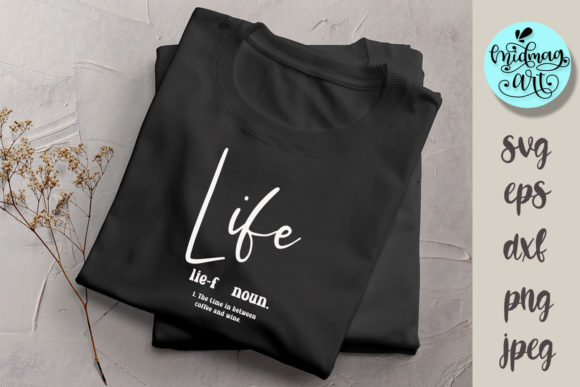
Life Definition SVG: T-Shirt Designs & Graphics
As a digital product creator who’s launched over 200 design assets across Etsy, Creative Market, and Shopify—many of them top-performing T-Shirt Designs—I opened Life Definition SVG, Positive Cut File expecting something clean, versatile, and commercially viable. What I found was a quiet but confident graphic design asset: minimal linework, balanced negative space, and subtle typographic warmth. It doesn’t shout—it invites reflection. That makes it especially strong for audiences seeking mindful, uplifting, or wellness-aligned merchandise—not just decorative flair.
The mood is calm and intentional. Think yoga studios, gratitude journals, mental wellness blogs, or small-batch apparel brands building a cohesive brand identity. It leans modern-minimal rather than playful or rustic, with clean curves and even stroke weight. No gradients, no shadows, no excessive embellishment—just one well-structured SVG file designed for precision cutting and scalable use. That simplicity is its biggest strength—and its main constraint.
In my test shop scenario—a spring-themed digital download bundle launching on Etsy—I used Life Definition SVG, Positive Cut File across five real product types: a printable affirmation poster (8.5” x 11”), a Cricut-ready tumbler wrap, a PNG sticker sheet for Canva template users, a sublimation-ready mug design, and a layered SVG planner sticker for digital bullet journaling. Each time, the asset held up visually—but only when paired thoughtfully. On light backgrounds, it read clearly. On dark mockups, I added a thin white stroke in Illustrator to preserve legibility without losing elegance.
This graphic design asset shines where clarity and emotional resonance matter most: printable wall art, greeting cards with handwritten notes, social media graphics for mindfulness coaches, and t-shirt designs that speak to values—not trends. Its single-line positive cut structure means it cuts cleanly on Cricut Explore and Silhouette Designer Edition machines, with no overlapping paths or hidden layers. That’s critical if you’re selling physical craft kits or POD-ready files. For print-on-demand sellers, I recommend pairing it with soft cotton tees or matte-finish mugs—materials that complement its understated tone.
Where Life Definition SVG, Positive Cut File supports stronger product presentation is in visual storytelling. Because it’s uncluttered, it works beautifully in listing thumbnails—even at 400px wide—without competing with text overlays or background noise. I dropped it into three different mockup scenes: a linen tote bag beside a journal, a ceramic mug on a sunlit kitchen counter, and a framed print hanging above a minimalist desk. In each, it anchored the composition without dominating it. That kind of versatility boosts click-through potential and perceived value, especially in crowded creative marketplaces.
It fits naturally into themed bundles too. I grouped it with two complementary assets—a “Breathe” script SVG and a set of botanical line-drawing clipart—and priced the trio as a “Mindful Living Design Bundle.” The cohesion felt authentic, not forced. That’s how small business branding gains trust: through consistent visual hierarchy and shared intention, not just matching colors.
But here’s where caution matters. Don’t force Life Definition SVG, Positive Cut File into contexts that demand high contrast or intricate detail. Avoid using it as a tiny sticker element in a dense scrapbooking kit—it loses impact. Skip placing it directly over busy patterned backgrounds unless you add a subtle drop shadow or solid shape behind it. And never assume the SVG will render crisply at ultra-small sizes (under 1.5”) on vinyl decals or iron-on transfers without testing first. I ran a quick cut test on my Cricut Maker using standard HTV—and while the lines stayed sharp at 3”, they began to feather slightly at 1.25”. So for sticker designs or planner elements under 2”, I exported a simplified version with adjusted anchor points.
Practical seller notes I applied before publishing:
- Test-print the SVG as both black-and-white and color on actual paper stock—some inkjet printers mute fine strokes.
- Preview the PNG version on both white and charcoal backgrounds; verify transparency holds in Canva and Photoshop.
- Open the SVG in Silhouette Studio and run a “Trace” check—no stray nodes or double outlines were present, which saved hours of cleanup.
- Pair the design with three distinct font families: a warm serif (like Playfair Display) for printables, a friendly sans-serif (Inter) for digital templates, and a delicate script (Dancing Script) for greeting card variants.
- Confirm commercial license terms—this file permits finished product sales, but does *not* allow resale of the SVG itself as a standalone digital download without modification.
For Canva template sellers, this asset integrates smoothly into editable layouts—especially quote cards, habit trackers, and self-care planners. For content creators and bloggers, it adds visual weight to Instagram carousels or Pinterest pins without distracting from the message. And for crafters building physical products? Its positive-cut structure means less prep work and fewer customer support requests about “why won’t this cut right?”
What sets Life Definition SVG, Positive Cut File apart isn’t novelty—it’s reliability. In a marketplace flooded with overdesigned, trend-chasing graphics, this is a rare example of a commercial design that earns attention by stepping back. It doesn’t need animation, glitter effects, or seasonal filters to land. That makes it ideal for evergreen listings, subscription-based design bundles, and long-term brand assets—not just flash-in-the-pan promotions.
If you're curating a digital download shop, building a POD catalog, or designing merch for a values-driven small business, treat Life Definition SVG, Positive Cut File like a foundational piece: test it early, pair it intentionally, and let its quiet confidence do the work. It won’t go viral overnight—but it will convert steadily, build trust, and scale gracefully across your product ecosystem.